
How to create a Banner (Display) campaign?
Banner campaigns show image or HTML ads in standard display sizes on publisher sites. They are billed per 1,000 impressions (CPM), with a $0.20 minimum bid in every country tier.
Format at a glance
Pricing model | CPM (you pay per 1,000 impressions) |
Minimum bid | $0.20 in all tiers |
Creatives | 1–5 per campaign |
Required per creative | Banner Size, image or HTML tag, Destination URL |
Steps
- In the sidebar, click Campaigns, then Create Campaign.
- In Basic Info, select Banner under Campaign Type. You can't change the type after the campaign is created.
- Enter a Campaign Name (3–200 characters) and select an Ad Vertical. Description, Schedule and Campaign Goals are optional.
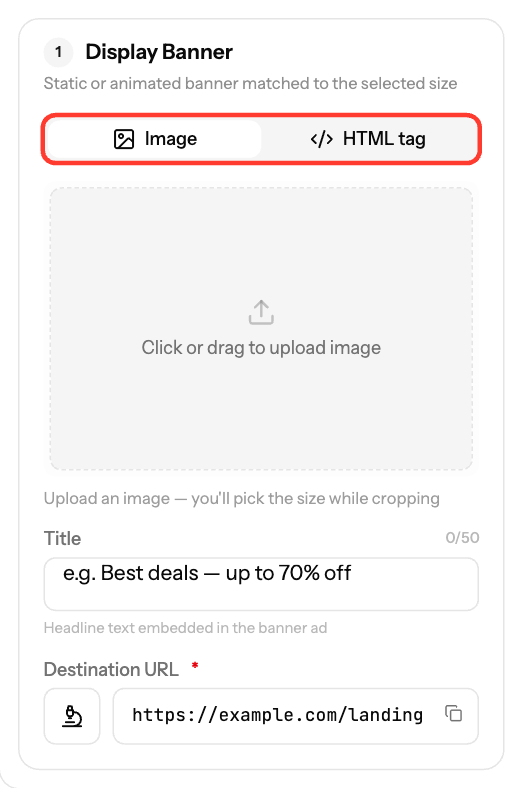
- Under Creatives, choose Image or HTML tag for each banner and fill in the fields (see below). Click Add creative to add more, up to 5.
- Click Next. In Targeting, choose countries, devices, schedule and lists, or leave them empty to run broadly.
- Click Next. In Budget & Launch, set your Bid and limits (see below).
- Check the review summary and click Create Campaign.
Creative requirements
Field | Required | Spec |
|---|---|---|
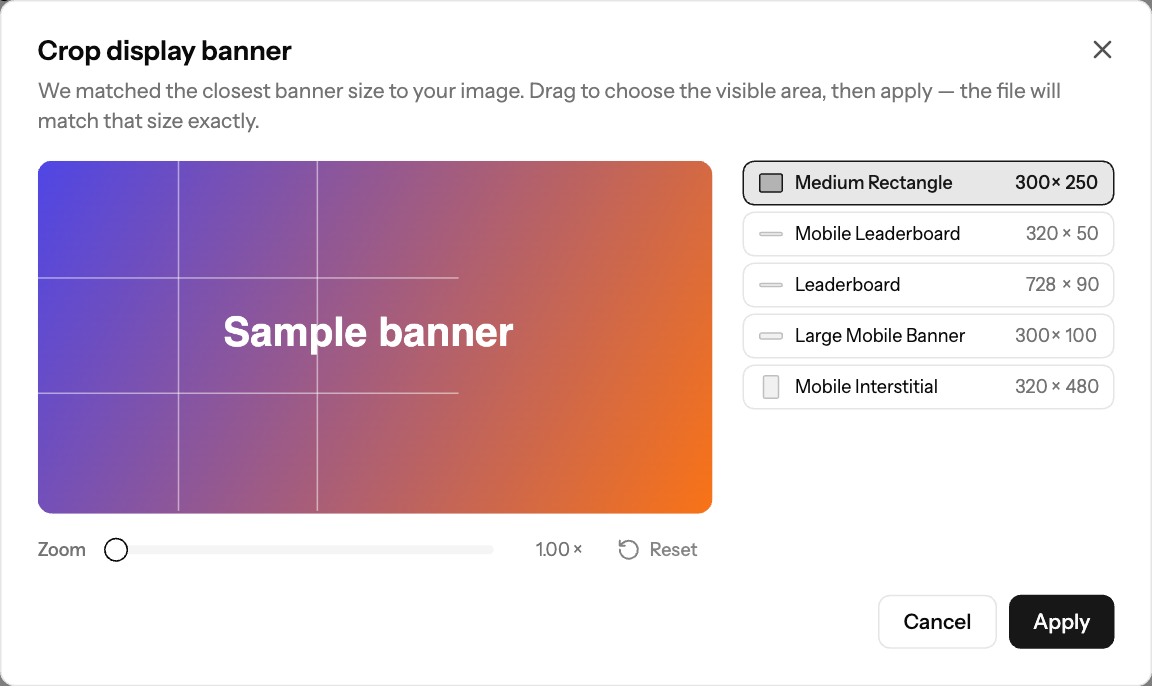
Image (Image mode) | Yes | JPG, PNG, WEBP, GIF or BMP, max 1 MB. You crop it to the selected size |
HTML tag (HTML tag mode) | Yes | Your own HTML or a third-party ad tag, up to 65,535 characters. It runs sandboxed at the selected size |
Banner Size | Yes | See the sizes below |
Title | No | Up to 50 characters. If left empty, one is generated from your ad's domain |
Destination URL | Yes | Must start with http:// or https://; tracking macros allowed |
The banner type (Image or HTML tag) and the size are set when the creative is created. To switch either, create a new creative.
Image banner sizes
Size | Name |
|---|---|
300 × 250 | Medium Rectangle |
320 × 50 | Mobile Leaderboard |
728 × 90 | Leaderboard |
300 × 100 | Large Mobile Banner |
320 × 480 | Mobile Interstitial |
Add several sizes as separate creatives to fit more placements. In Targeting, Banner campaigns also have Traffic Type (websites, apps or both).
Budget & Launch settings
Field | Rule |
|---|---|
Bid | At or above the tier minimum. The wizard suggests Min, Avg and Rec bids |
Total Budget | Optional. At least $50, or No limit |
Daily Cap | Optional. At least $10; resets at midnight UTC |
Budget Type | ASAP or Evenly |
Frequency Cap | Optional. 1–100 impressions per unique IP in 24 hours |
New creatives are reviewed before they serve traffic.
Screenshots
Related articles
- Campaign Creation: The Complete Guide
- Video Campaign Creation Guide
- How high or low should I bid?
- How to add domain targeting to a campaign?
- How long does it take for campaign approval?
Updated on: 27/09/2026
Thank you!